
DBOS is the leading Temporal alternative for teams that need durable, fault-tolerant workflows without adding high operational and infrastructure costs. Unlike Temporal, which requires a separate orchestration server and Cassandra data cluster to host, DBOS runs as a library inside your existing application and stores workflow state directly in Postgres, which makes it faster to adopt, cheaper to run, and simpler to operate.

of durable workflows per day
new infrastructure required
lock-in












DBOS is a library you install, not a service you run. If you already use Postgres, you already have everything you need.
Install the open-source library, connect to Postgres, annotate your workflows and steps. No cluster to provision, no orchestration server.
Control concurrency globally, per-worker, or per-tenant. Temporal has no comparable queueing abstractions.
Each step checkpoint is a single Postgres write. Temporal's async dispatch model adds tens to hundreds of milliseconds per step.
Workflow checkpoints live in your Postgres. Nothing is sent to an external server. No sensitive data ever leaves your infrastructure.
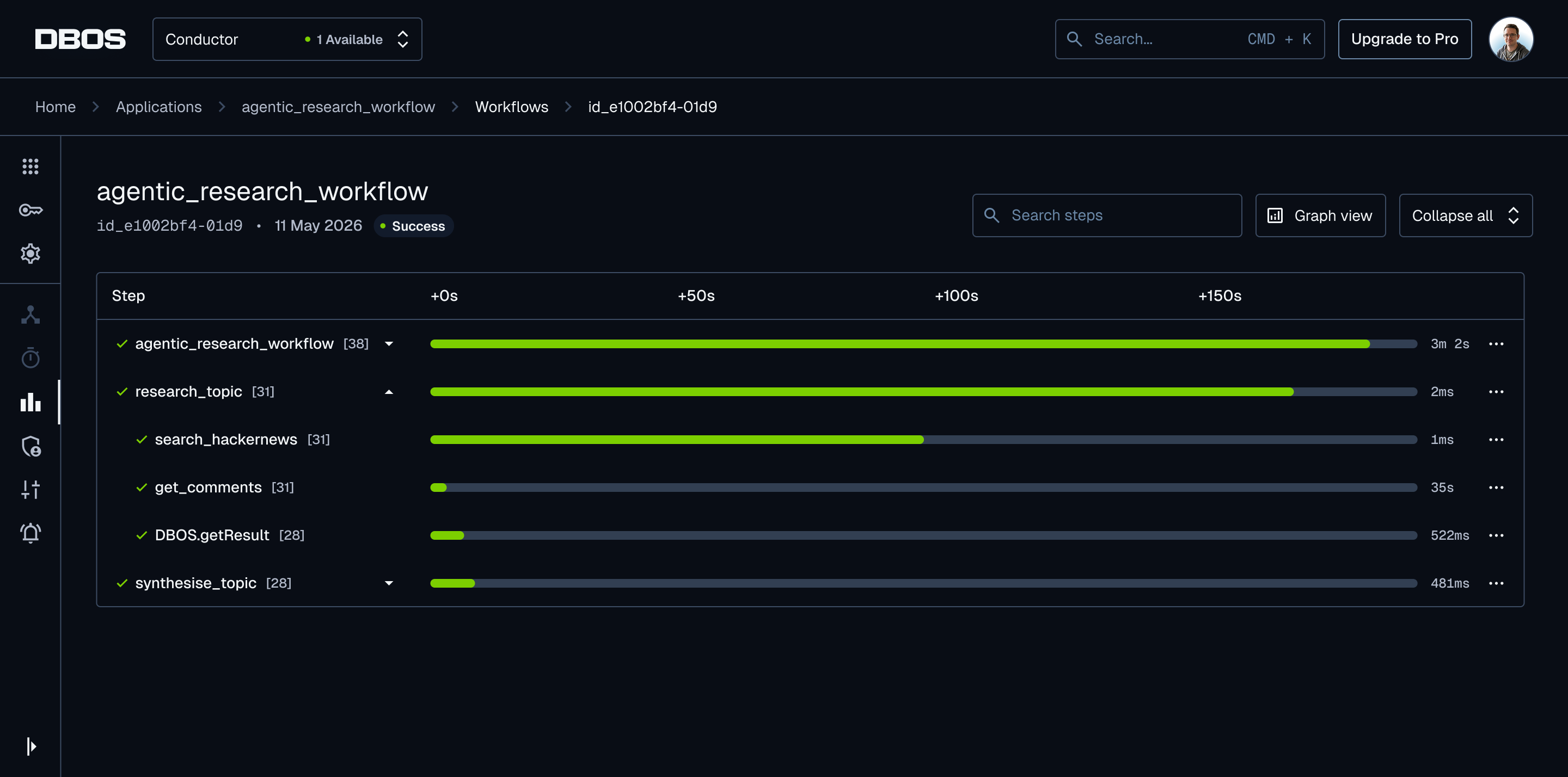
Search, pause, cancel, or resume workflows using SQL. Fork any workflow from any step, programmatically or from the web UI.
DBOS only depends on Postgres. Temporal adds two: the Temporal server and its Cassandra data store each a new operational risk.
Take DBOS to prod with simple annotations on the functions that already exist in your codebase. With Temporal, you move your code into workers, configure a server, and require a rewrite on your app & workflows.
1. Install the open-source library
1. Provision and operate a Temporal server
2. Connect to your existing Postgres
2. Set up Cassandra as the backing data store
3. Add @DBOS.workflow() and @DBOS.step() decorators
3. Build and scale a cluster of Temporal workers
4. Deploy your application exactly as before
4. Rewrite app & workflow interactions via Temporal API


License
MIT
MIT / Apache 2.0
Architecture
LIbrary (no server)
External orchestration service
Step latency
1 to 2 ms (Postgre write)
Tens to hundreds of ms
Infrastructure required
Postgres only
Temporal server & Cassandra
New points of failure
None (only Postgres)
2+ (Temporal server, Cassandra)
Adoption effort
Install library, annotate code
Full application rearchitecting
Workflow introspection
SQL queries + Web UI
Temporal UI + custom queries
Fork / restart from step
Yes, first-class feature
Not available
Data privacy
Your Postgres, your data
Via Temporal server
Durable queues
Built-in with flow control
Built-in with flow control
Running DBOS is often 2-10x less expensive than running Temporal.
Incremental infrastructure costs?
$0
$$$, to host and run Temporal and Cassandra clusters.
Incremental people costs
$0
$$$ - 2 to 10 full time employees required to operate Temporal cluster (source: Temporal)
Workflow concurrency, capacity, throughput, scheduling, and storage limits.
$0 or none
Yes (Temporal Cloud). Extra cost to increase.
DBOS is a popular alternative to Temporal. Customers like Yutori, Roche, Notion, and others have chosen DBOS over Temporal.
DBOS is based on years of R&D at Stanford and MIT, led by the creator of Postgres, Mike Stonebraker and Databricks CTO and co-founder, Matei Zaharia. The big idea behind DBOS is to embed durability into your code via a library, rather than having to run a heavyweight workflow orchestration server external to your application as with Temporal.
The bottom line: Temporal requires extra infrastructure and a rearchitecture of your application. DBOS requires minimal coding changes and no external orchestration server to operate, making it simpler and much less costly than Temporal.

Software
DBOS workflows deploy thousands of isolated Palantir software stacks per day to Palantir trainees.

AI - Agentic ERP Ops
FlowGen Labs selected DBOS over Temporal to make long-lived workflows durable and observable within the rigid security constraints of customer environments, including air-gapped deployments.
DBOS covers the same core use case — durable, fault-tolerant workflows — but with a fundamentally different architecture. The programming model is similar (annotate workflows and steps), but migrating requires updating annotations and removing Temporal-specific SDK calls. See the migration guide at docs.dbos.dev for a step-by-step walkthrough.
No. DBOS is just a library that runs inside your existing application process. You don't need to provision new servers, change your deployment pipeline, or run separate worker fleets. If you have Postgres, you're ready.
DBOS has exactly one point of failure: Postgres. Most teams already run Postgres and have established monitoring, backups, and SLAs for it. Temporal adds two new failure domains — the Temporal server and its Cassandra data store — that your team must operate independently.
Fork lets you restart a workflow from any specific step, either programmatically or from the web UI. This is invaluable when a batch of workflows fail due to a bug or third-party outage: once the issue is resolved, you can resume all affected workflows exactly from the failed step, without rerunning earlier work.
Yes. This is one of DBOS's key advantages. Because each step checkpoint is a single Postgres write (1–2ms), DBOS is well-suited for interactive or otherwise latency-sensitive workflows. Temporal's async dispatch architecture adds tens to hundreds of milliseconds per step, making it less suitable for these scenarios.
DBOS works with any Postgres-compatible database, including Amazon Aurora, Supabase, Neon, and standard Postgres. If your application already connects to Postgres, no additional database infrastructure is required.
Get durable workflows without the operational overhead.