Open source
durable execution
Annotate your existing code in minutes, and make your applications fault-tolerant and observable by default. No orchestration server required.


Open source durable execution
"Makes it impossible to mess up."
@DBOS.workflow()
def customer_workflow(scheduled_time: datetime,
customer_id: str):
    # Code to sync customer data
    ...

def on_customer_registration(customer_id: str):
    # Create a schedule dynamically per user
    # to run the customer_workflow
    DBOS.create_schedule(
        schedule_name=f"cus-{customer_id}-sync",
        workflow_fn=customer_workflow,
        schedule="0 * * * *",  # Runs every hour
        context=customer_id,
    )
Zero infrastructure
No new infrastructure
Run anywhere
Run DBOS anywhere.
Features
Like putting a PhD in your code
The open source DBOS Transact library simplifies workflow and AI agent idempotency, concurrency, observability and other backend complexities.
Reliable agents and workflows
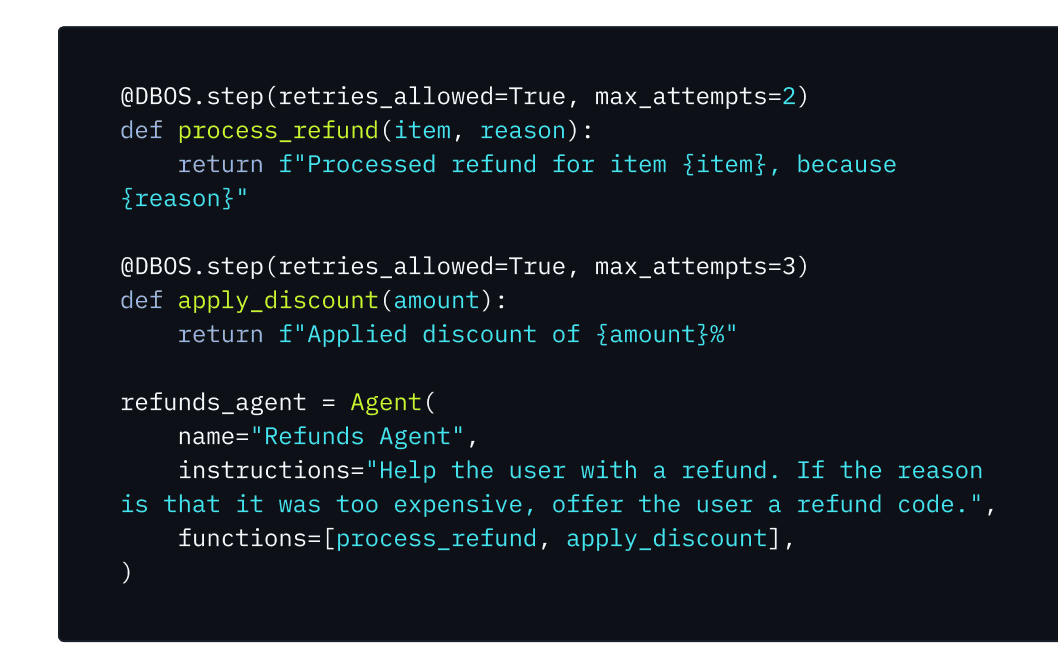
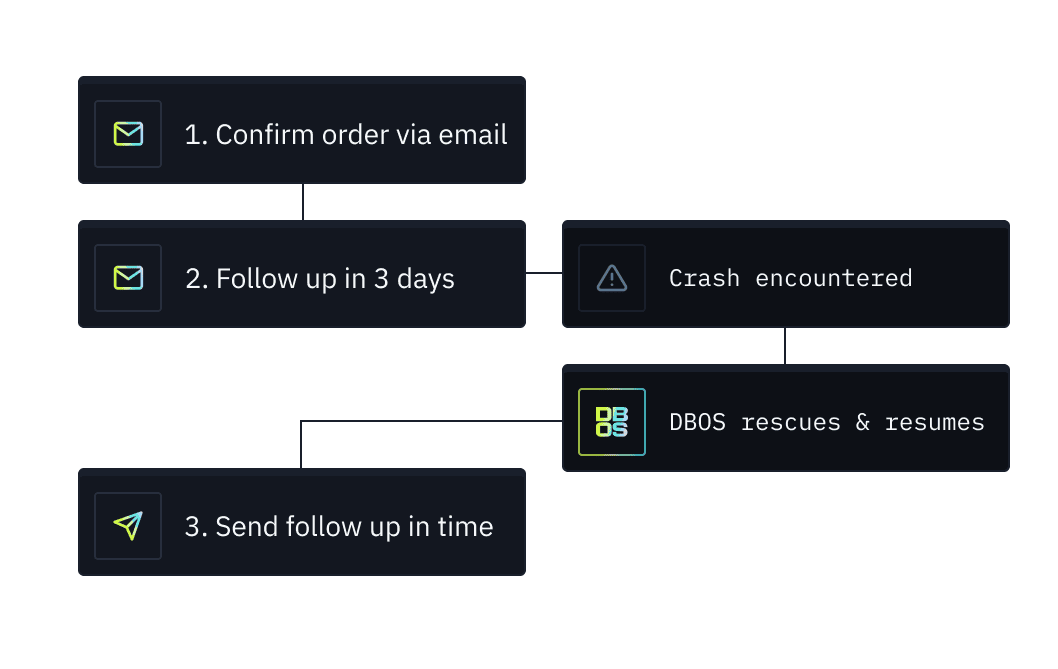
Annotate workflows and steps in your existing code. Checkpoint LLM and tool calls, wait days for a human approval, and resume after crashes without repeating work.
Durable queues with flow control
Postgres-backed queues with concurrency limits, rate limits, timeouts and priorities, integrated with workflows. No separate message broker.
Agent and workflow observability
Every workflow and step is recorded in Postgres, where you can query it with SQL. DBOS also emits OpenTelemetry logs, traces and metrics.
Scales with Postgres
In a published benchmark, DBOS ran over 1 million durable workflows per second across 50 Postgres shards, scaling near-linearly.
Runs where you run
Deploy in your own cloud, on-premises or in air-gapped environments: anywhere your application and Postgres can run. There is no orchestrator to deploy.
Operate in production with confidence
All DBOS paid plans include access to DBOS Conductor for workflow monitoring and management, plus advanced features like horizontal sharding, automatic workflow upgrades, workflow suspension, configurable retention, and external storage.
Build with your favorite tools.
Deploy anywhere.
FAQs
Quick answers
Do I have to rewrite my application to use DBOS?
No. DBOS integrates into your existing application. You can make selected functions durable by defining them as workflows and steps, without rewriting your entire codebase or adopting a new application framework.
How is DBOS different from other workflow orchestrators?
DBOS runs durable workflows, background jobs, queues, and scheduling directly inside your application, using your existing Postgres database. Unlike solutions that require an external orchestrator to maintain or depend on, DBOS simplifies deployment and reduces infrastructure overhead. DBOS Conductor adds observability, management, and automated distributed recovery.
Compare DBOS with other workflow orchestrators
Do I need cloud hosting to run DBOS Transact?
No. DBOS Transact is an open-source library you can run locally, on-premises, or in any cloud environment. For production workloads, DBOS recommends Postgres for durable state storage. Some SDKs also support SQLite for local development and testing.
Do I need DBOS Conductor to run DBOS Transact applications?
No. DBOS Transact can execute and recover durable workflows without Conductor. For applications running across multiple processes, Conductor coordinates automated recovery when a worker fails. It also provides workflow observability, management, alerting, and retention policies. We recommend Conductor for production deployments, particularly distributed applications.
The easiest way to build reliable backends
Build 10x faster
DBOS Transact makes it durable and observable for you.
Reliable by default
Observable by default