



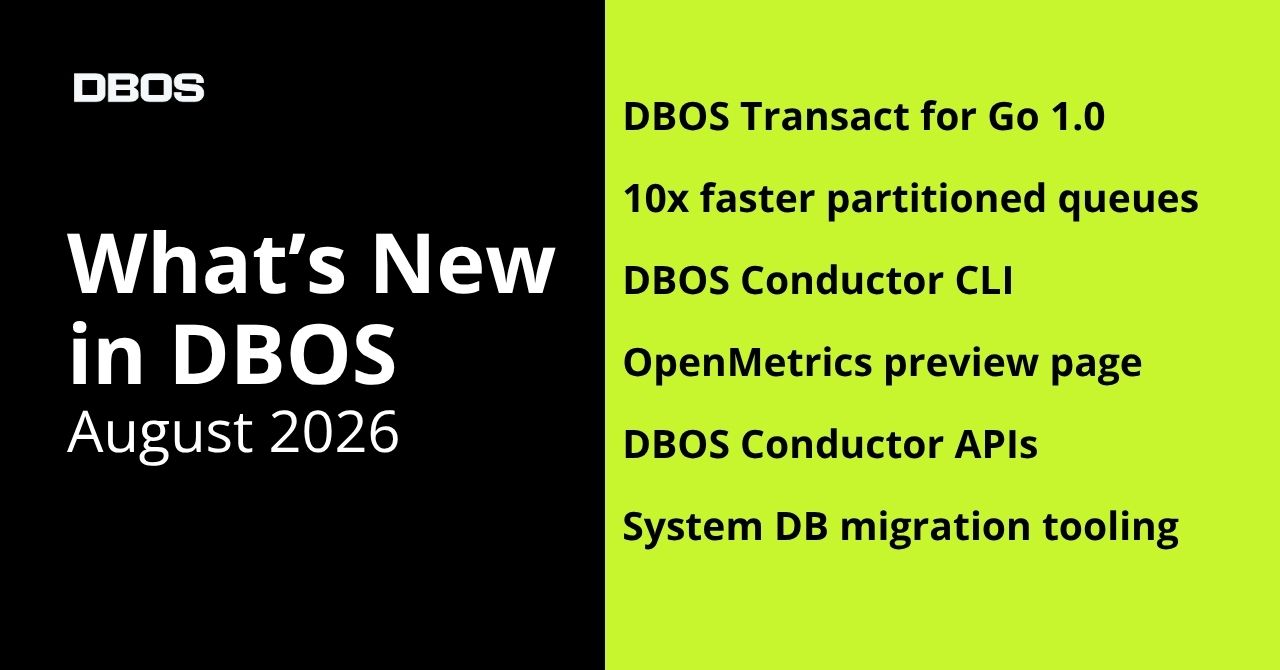

Over the past month, the DBOS product team has focused heavily on two areas: workflow operations tooling and performance optimization. We introduced a new timeline visualization on DBOS Conductor, dynamic database-backed queue configuration, major scalability optimizations, improved Java and Go feature parity, and several new ecosystem integrations.
Here’s a summary of what’s new:
New in DBOS Transact open source libraries
- Major performance improvements
- Database-backed dynamic queue configuration
- DBOS Golang v0.14
- DBOS Java v0.8
New in DBOS Conductor
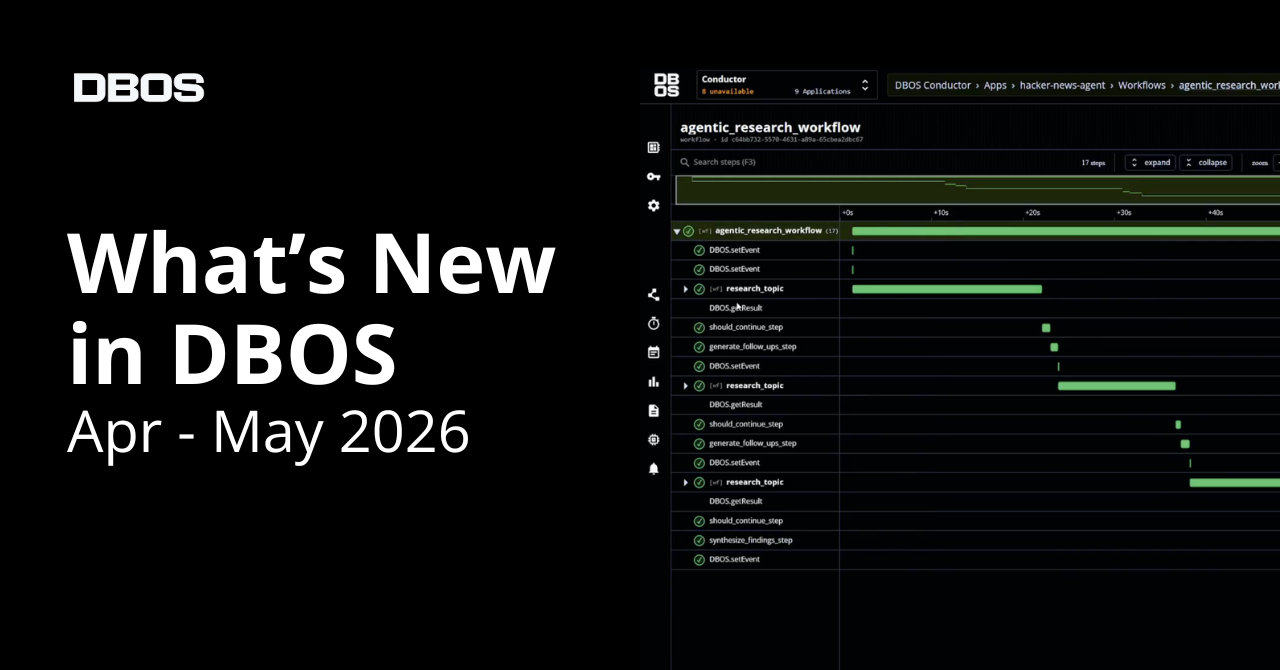
- Timeline visualization for workflows and steps
New DBOS integrations
- Spring Boot integration
- Cockroach Labs partnership
Read on for the details.
New Features in DBOS Transact
Major Performance Improvements
We recently benchmarked DBOS scalability on a single Postgres server to show how well workflow durability scales on Postgres. A single server can support a sustained throughput of 144K writes per second, or process 43K workflows per second. That translates to 4 billion workflows per day, more than enough for most use cases.
Along the way, we introduced several queue and storage optimizations that significantly improved throughput and reduced database overhead:
- Tracking local worker concurrency in-memory instead of in the database.
- Reducing transaction isolation to READ COMMITTED when global concurrency or rate limits are not required.
- Adding new partial indexes to reduce write amplification and autovacuum churn on the workflow_status table
Watch DBOS CTO Peter Kraft present on scaling Postgres
Read the benchmarking blog post
Database-Backed Dynamic Queue Configuration
Queue definitions are now persisted in the database, making them observable and configurable at runtime through DBOS APIs and the DBOS Client. This enables creating queues dynamically, and reconfiguring queues without restarting workers.
New public APIs for queue configuration:
- register_queue: Register a queue and persist its configuration to the system database.
- The following queue properties can now be updated dynamically at runtime. Workers automatically pick up new configurations during their next polling cycle without requiring a restart:
- concurrency
- worker concurrency
- rate limiters
- priority
- partitions
- polling intervals

The new API is fully backwards compatible, so existing queues continue to work unchanged.
Read the docs: TypeScript, Python (Go and Java support coming soon)
DBOS Golang v0.14
The latest Go release continues improving feature parity with the Python and TypeScript libraries. The new features include:
- Workflow delay scheduling: You can now enqueue a task and have it dequeue after a delay, or at a specified deadline. Docs
- Dynamic workflow scheduling: Workflow schedules are stored in Postgres, allowing you to create schedules dynamically at runtime, view and update schedules, backfill missed runs, and manually trigger executions. Docs
DBOS Java v0.8
DBOS Java v0.8 marks another major step toward the v1.0 release.
This release improves ergonomics for Java developers while continuing to close feature gaps with the Python and TypeScript libraries. The new features include:
- Workflow delay scheduling: Docs
- Dynamic workflow scheduling: Docs
- Improved application versioning: Application versions are now persisted in the database, making them observable and controllable at runtime. Docs
- Spring Boot integration: Docs
This release also includes several API renames and breaking changes. We do not expect additional breaking changes before v1.0, after which DBOS Java will follow a standard SemVer deprecation policy.
Read the release notes and upgrade guide.
New Features in DBOS Conductor
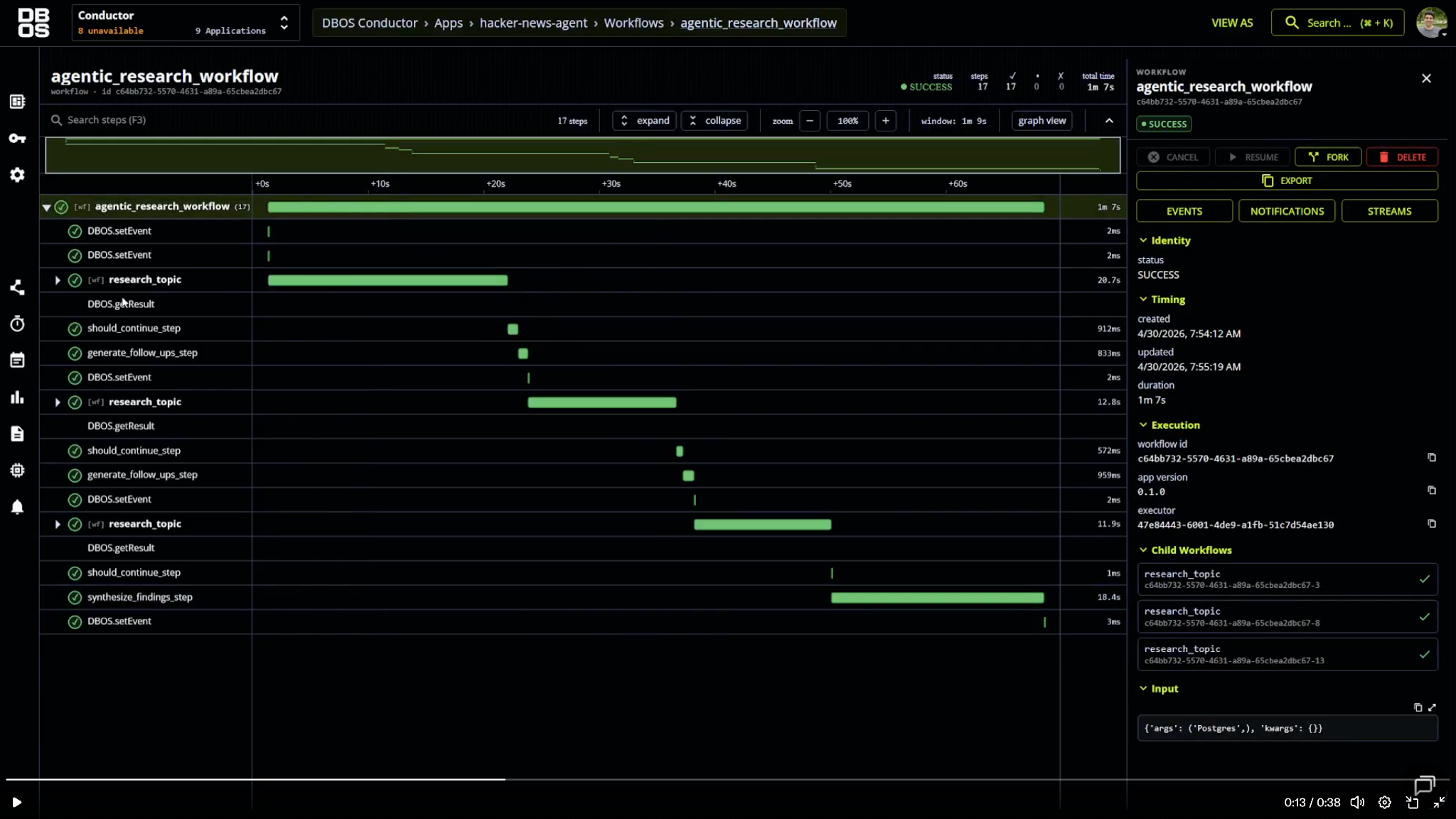
Timeline Visualization For Workflows And Steps
DBOS Conductor now includes a timeline trace visualization for workflows, which shows how they're spending time and which steps ran when.
The new timeline view makes it easier to:
- Understand workflow execution patterns
- Identify slow or blocked steps
- Visualize parallel execution
- Quickly jump to failed workflows and steps
In addition, the visualization is optimized for deeply nested workflows, workflows that run for days, and workflows with millions of steps.
This significantly improves debugging and operational visibility for large-scale workflow systems.
New Partnerships and Integrations
Spring Boot Integration
Included in Java v0.8 is a new Spring Boot integration through the DBOS Transact Spring Boot Starter package.
The starter package dramatically reduces setup and configuration code for Java applications using DBOS. It also integrates with Spring's Aspect Oriented Programming (AOP) framework to simplify implementation of DBOS @Workflow methods on Spring @Service classes.
Cockroach Labs Partnership
We are now an official partner of Cockroach Labs. Together, DBOS and CockroachDB help developers build reliable, fault-tolerant AI agents and workflows that scale globally by default.
Why CockroachDB + DBOS?
- DBOS uses CockroachDB as its durable execution state store, enabling teams to build long-running, auditable, exactly-once AI workflows that can run at any scale.
- CockroachDB provides globally consistent transactions and multi-region deployment support.
- The combination enables auditable, resilient AI systems with strong operational guarantees.
Listen to the Big Ideas in App Architecture podcast interview with DBOS CTO Peter Kraft.
Learn More about Durable Workflow Orchestration
If you like making systems reliable, we'd love to hear from you. At DBOS, our goal is to make durable workflows as easy to work with as possible. Check it out:
- Quickstart: https://docs.dbos.dev/quickstart
- GitHub: https://github.com/dbos-inc
- Discord community: https://discord.gg/eMUHrvbu67